



Faculty of Economics
Today’s economy, tomorrow’s progress
Brief introduction to the Faculty of Economics
Dated: 19 May 2010
Introduction to the faculty
The Faculty of Economics of Taj University is one of the leading faculties offering specialised bachelor’s-level education. It was established in 2010 with an official licence and on the basis of labour-market needs. The faculty works through two departments, Accounting and Management, and Administration and Business, and with scientific and practical teaching prepares students to enter economic, managerial and commercial fields. The Department of Accounting and Management concentrates on teaching financial skills, accounting and organisational management, and its graduates can work in organisations, companies and financial institutions as financial managers, accountants and economic analysts. The Department of Administration and Business introduces students to modern concepts of business management, business strategies and the principles of entrepreneurship and prepares them to play a role in management, marketing and economic development. The faculty aims to train specialists who, with a thorough understanding of economic and management principles, can play an effective role in analysing economic systems and in economic planning and policy-making. Using their scientific and practical knowledge, the faculty’s graduates are effectively present in the country’s industrial, commercial and administrative sectors and play a part in sustainable economic development.
Lecturer profilesVision and mission
Faculty of Economics
Vision
Over the next five years, within the framework of Islamic and national values and following the eleven quality-enhancement standards, the Faculty of Economics of Taj University will train capable, committed human resources so as to establish itself as a leading faculty nationally, play its part in spreading and developing economic knowledge and creating the ground for entrepreneurship in the country, and help strengthen the academic credibility of Taj University.
Faculty of Economics
Mission
Using experienced, specialist staff, developing applied scientific research and using up-to-date information technology, the Faculty of Economics of Taj University offers standard academic services in the economic sciences and, by training professional and committed people, strives to play an effective role in improving and developing the country’s economic knowledge.
Core values of the faculty
1: Islamic and national values
2: Teamwork
3: Commitment and respect for the law
4: Expertise and merit
5: Creativity and innovation
6: Ethical conduct and behaviour
Department-related material
Introduction to the Department of Administration and Business
The Department of Business Administration is another core part of the Faculty of Economics, and its aim is to teach students management and business. The main aim of this field is to give a precise familiarity with the basic tasks of commercial organisations, to raise students’ skill and ability in recognising management problems, collecting and analysing information about them, evaluating different solutions, and making and carrying out decisions. In this course, by learning modern theories of business administration, students will be able to carry out research as researchers and, through specialist analysis of management problems, to help organisations run successfully. Some of the jobs related to this field are: marketing jobs at different levels from marketer to marketing manager, work in companies’ brand or market-research sections, organisations’ sales units, international trade (exporting and importing goods), work in insurance, e-commerce, and the management of institutions, companies and banking. The Department of Business Administration strives, through applied and research-based teaching, to turn students into capable specialists in business and management.
A clear definition of a graduate of the Administration and Business programme
The programme (Administration and Business) of the Faculty of Economics (Taj Private Institution of Higher Education) was created to train specialist and professional staff for (government offices, production, trade and service companies, non-profit organisations and international organisations). On this basis, the programme regards as its bachelor’s graduate a person who has completed (156) credits over a 4-year course (8 semesters) in the day and evening sections and who has the following in knowledge, skills and conduct:
1. Knowledge: a graduate of the Administration and Business programme should, at bachelor’s level, command the subjects (economics, finance and accounting, management, human resources, domestic and foreign trade) and have mastery of the four language skills (listening, speaking, reading and writing), so as to make a mark in society as a specialist in (administration and business).
2. Skills: a graduate of the programme (Administration and Business) is a person with the necessary familiarity with (basic economic topics, business administration, management and human resources, accounting for companies and government bodies, and domestic and foreign trade) and the ability to solve problems in this area.
3. Conduct: a graduate of the programme (Administration and Business) is a person who, through the content of their professional subjects (management and business) and respect for the country’s laws, has absorbed academic ethics, patriotism and high Islamic, human and moral values, is committed to all these values, and is free of any kind of discrimination and prejudice.
Specifications of the Department of Administration and Business
Academic programme: Business Administration
Academic programme in English: (Business Administration)
Faculty: Economics
Level: Bachelor’s
Type of graduation certificate: BA
Years of study: four years
Number of semesters: 8 semesters
Teaching weeks per semester: (16 teaching weeks)
Course system: credit system
Admission requirements: a twelfth-grade school graduation certificate, a passing mark in the Kankor exam, and meeting the conditions set out in the Ministry’s regulations
Curriculum of the Department of Administration and Business
| First semester
Business Administration |
Second semester
Business Administration |
Third semester
Business Administration |
Fourth semester
Business Administration |
Fifth semester
Business Administration |
Sixth semester
Business Administration |
Seventh semester
Business Administration |
Eighth semester
Business Administration |
|---|---|---|---|---|---|---|---|
|
Macroeconomics 1 (2) |
Macroeconomics 2 (2) |
Macroeconomics 3 (2) |
History of economic thought (2) |
International economics (3) |
Research methods (3) |
Banking (3) |
Islamic economics (3) |
|
Microeconomics 1 (2) |
Microeconomics 2 (2) |
Microeconomics 3 (2) |
Consumption measurement 2 (2) |
Public budget (3) |
Regional economics (3) |
Entrepreneurship management (3) |
Strategic management (3) |
|
Financial accounting 1 (3) |
Financial accounting 2 (2) |
Probability (2) |
Communication management (3) |
Development economics (3) |
E-commerce (3) |
Financial management (3) |
Business plan (2) |
|
Mathematics 1 (2) |
Mathematics 2 (2) |
Monetary economics (2) |
Marketing management (3) |
Project management (3) |
Human resource management (3) |
Economic policies (3) |
Government accounting (3) |
|
Statistics 1 (2) |
Statistics 2 (2) |
English for business (2) |
Finance and investment (3) |
International marketing (3) |
Business management (2) |
Risk management (3) |
Monograph (3) |
|
Principles of law (2) |
Fundamentals of management (2) |
Fundamentals of public finance (2) |
Organisational behaviour (2) |
Operations research (2) |
Procurement (3) |
Computer for statistics (2) |
Practical work (3) |
|
Islamic creed (2) |
Islamic system of worship (2) |
Consumption measurement 1 (2) |
Intellectual education (2) |
Islamic political system (2) |
Islamic economic system (2) |
The Quran and the sciences (2) |
Islamic civilisation (2) |
|
Recitation and tajweed (1) |
Biography of the Prophet (2) |
Islamic ethical system (2) |
Religions and sects (1) |
Islamic administrative system (2) |
|||
|
Contemporary history of Afghanistan (2) |
English 2 (2) |
Islamic social system (2) |
|||||
|
English 1 (2) |
Computer fundamentals (2) |
||||||
| Total credits (20) | Total credits (18) | Total credits (20) | Total credits (18) | Total credits (21) | Total credits (19) | Total credits (19) | Total credits (19) |
Introduction to the Department of Accounting and Management
The Department of Accounting and Management is one of the key sections of the Faculty of Economics and was established to teach students finance, accounting and organisational management. Accounting is in effect an orderly system in which information is collected, categorised, recorded and summarised, and financial reports and accounting statements are prepared in various forms. For this purpose, the Department of Accounting and Management of the Faculty of Economics, by offering a comprehensive teaching programme based on labour-market needs, strives to turn students into specialist and efficient staff in accounting, finance and management. In line with the Faculty of Economics’ strategic aims, this programme is updated continuously and uses modern teaching methods and financial technologies so that graduates can succeed in today’s competitive market.
A clear definition of a graduate of the Accounting and Management programme
The programme (Accounting and Management) of the Faculty of Economics (Taj Private Institution of Higher Education) was created to train specialist and professional staff for (government offices, production, trade and service companies, non-profit organisations and international organisations). On this basis, the programme regards as its bachelor’s graduate a person who has completed (156) credits over a 4-year course (8 semesters) in the day and evening sections and who has the following in knowledge, skills and conduct:
1. Knowledge: a graduate of the programme (Accounting and Management) should, at bachelor’s level, command the subjects (economics, finance and accounting, auditing and account inspection, management and human resources) and have mastery of the four language skills (listening, speaking, reading and writing), so as to make a mark in society as a specialist in (accounting and management).
2. Skills: a graduate of the programme (Accounting and Management) is a person with the necessary familiarity with (basic economic topics, accounting and auditing of companies and government bodies, business administration, management and human resources, and domestic and foreign trade) and the ability to solve problems in this area.
3. Conduct: a graduate of the programme (Accounting and Management) is a person who, through the content of their professional subjects (accounting and management) and respect for the country’s laws, has absorbed academic ethics, patriotism and high Islamic, human and moral values, is committed to all these values, and is free of any kind of discrimination and prejudice.
Specifications of the Department of Accounting and Management
Academic programme: Accounting and Management
Academic programme in English: (Accounting and Management)
Faculty: Economics
Level: Bachelor’s
Type of graduation certificate: BA
Years of study: four years
Number of semesters: 8 semesters
Teaching weeks per semester: (16 teaching weeks)
Course system: credit system
Admission requirements: a twelfth-grade school graduation certificate, a passing mark in the Kankor exam, and meeting the conditions set out in the Ministry’s regulations
Curriculum of the Department of Accounting and Management
| First semester
Accounting and management |
Second semester
Accounting and management |
Third semester
Accounting and management |
Fourth semester
Accounting and management |
Fifth semester
Accounting and management |
Sixth semester
Accounting and management |
Seventh semester
Accounting and management |
Eighth semester
Accounting and management |
|---|---|---|---|---|---|---|---|
|
Macroeconomics 1 (2) |
Macroeconomics 2 (2) |
Macroeconomics 3 (2) |
History of economic thought (2) |
Principles of auditing (3) |
Principles of auditing 2 (3) |
Banking (3) |
Credit management (3) |
|
Microeconomics 1 (2) |
Microeconomics 2 (2) |
Microeconomics 3 (2) |
Consumption measurement 2 (2) |
Public budget (3) |
Monetary policies (3) |
Control and inspection (3) |
Financial modelling (3) |
|
Financial accounting 1 (3) |
Financial accounting 2 (2) |
Probability (2) |
Communication management (3) |
Industrial accounting (3) |
Human resource management (3) |
Budgeting (3) |
General insurance (2) |
|
Mathematics 1 (2) |
Mathematics 2 (2) |
Monetary economics (2) |
Marketing management (3) |
Taxation (3) |
Time management (2) |
Financial risk management (3) |
Financial markets (3) |
|
Statistics 1 (2) |
Statistics 2 (2) |
English for business (2) |
Finance and investment (3) |
Financial management (3) |
Procurement (3) |
Commercial law (2) |
Monograph (2) |
|
Principles of law (2) |
Fundamentals of management (2) |
Fundamentals of public finance (2) |
Organisational behaviour (2) |
Operations research (2) |
Research methods (3) |
Computer for accounting (3) |
Fundamentals of the environment (2) |
|
Islamic creed (2) |
Islamic system of worship (2) |
Consumption measurement 1 (2) |
Intellectual education (2) |
Islamic political system (2) |
Islamic economic system (2) |
The Quran and the sciences (2) |
Islamic civilisation (2) |
|
Recitation and tajweed (1) |
Biography of the Prophet (2) |
Islamic ethical system (2) |
Religions and sects (1) |
Islamic administrative system (2) |
Ethical principles of accounting (2) |
||
|
Contemporary history of Afghanistan (2) |
English 2 (2) |
Islamic social system (2) |
|||||
|
English 1 (2) |
Computer fundamentals (2) |
||||||
| Total credits (20) | Total credits (18) | Total credits (20) | Total credits (18) | Total credits (21) | Total credits (21) | Total credits (19) | Total credits (17) |
Strategic plan of the Faculty of Economics 2025–2029
Download the strategic planImplementation plan report
This is the first-quarter report of the approved implementation plan for 2025; the report is as follows.
Download the reportAcademic staff of the faculty
| Name | Job title | Level of education | Field of study |
| Assistant Professor Liaqat Ali “Akhlaqi” (permanent) | Dean of the faculty, academic staff | Master’s | Economics |
| Assistant-professor candidate Sifatullah “Molan” (permanent) | Head of the Department of Business Administration, academic staff | Master’s | Economics |
| Assistant Professor Mohammad Bashir “Behrangi” (permanent) | Head of the Department of Accounting and Management, academic staff | Master’s | Economics |
| Assistant Professor Abdul Hakim “Haidari” (permanent) | Academic staff | Master’s | Economics |
| Assistant Professor Ahmad Sir “Akbari” (permanent) | Academic staff | Master’s | Economics |
| Sayed Mohammad “Sharifi” (permanent) | Manager of the entrepreneurship centre, academic staff | Master’s | Economics |
| Sayed Farhad “Hashemi” (permanent) | Teaching manager | Bachelor’s | Law and Political Science |
Experience the best with us
The Faculty of Economics strives to create the ground for research-based teaching, to train professional and committed staff, and to work to provide useful services to society.
Five-year plan
Drafting and approving a strategic plan for every five years in line with planning standards and the faculty’s needs
Research articles
Writing and printing research articles by the faculty’s academic staff in reputable national and international, domestic and foreign journals
Student programmes
Quality-improvement workshops, practical programmes, field trips and dozens of extra-curricular programmes
Goals of the faculty
- Creating the ground for standard teaching for those interested in law and political science
- Training specialist, professional and committed staff in law and political science
- Providing quality, standard services to raise students’ theoretical and practical skills
- Creating a suitable academic environment free of ethnic, racial and sectarian prejudice, observing Islamic, national and Afghan principles and norms
- Developing scientific research and creating suitable opportunities for lecturers and students to start scientific research in line with market needs
- Developing material facilities to offer quality academic services in theory and practice
- Raising the capacity of academic and administrative staff and improving the quality of teaching in the faculty
- Strengthening and developing students’ professional ethics and skills in building social relations in the workplace
Strategic goals of the faculty
- Raising quality and preparing the ground for passing the stages of obtaining accreditation
- Developing research and scientific publications
- Improving twinning arrangements and scientific agreements
- Completing the permanent academic staff
- Raising the capacity of academic staff
- Developing e-learning
- Developing the curriculum
- Creating new academic programmes
- Creating programmes to strengthen students
- Developing human resources
- Developing infrastructure
- Developing administration and organisation
- Good governance
- Increasing transparency and fighting administrative corruption
- Increasing student numbers
- Increasing fair access to higher education
- Placing the faculty on the path of entrepreneurship
- Creating extra-curricular programmes
Achievements
- Fifteen successful graduating classes from the Faculty of Economics
- Signed agreements with various state and private bodies
- An approved strategic plan in place
- Teaching courses by the outcome-based, student-centred learning method (OBE-SCL)
- Graduates employed in various state and private bodies, and several of them studying at master’s level at home and abroad
- Holding field trips for students every semester
- Holding various capacity-building programmes for students, such as how to start small businesses, World Bank simulation, research methods, CV writing and more
- Lecturers taking part in various capacity-building programmes outside the institution, such as presenting scientific research papers at international conferences
- Naming the top researching lecturers of 2022 and 2023 from the Faculty of Economics at institution level
- The Faculty of Economics chosen as the institution’s top faculty by the leadership in 2022 and 2024
- Introducing students to internship opportunities in various state and private organs
- More than 20 scientific research articles by academic staff printed and published in reputable international journals
- More than 10 scientific research articles presented by academic staff at international conferences
- Fourteen scientific research articles presented by academic staff at institution level and printed in the collection of scientific research articles
- Dozens of scientific webinars given by academic staff at institution level
- More than 40 articles presented by students at institution level and printed in the collection of student articles
- Third place for Taj Institute of Higher Education’s student design at the Urban Culture conference in 2021
Committees of the Faculty of Economics
| Committee | Chair and secretary | Chart and regulation |
|
Quality Enhancement Committee |
Sifatullah Molan |
Download the organisation chart Download the job description |
|
E-learning Committee |
Abdul Khaliq Qarizada |
Download the organisation chart Download the job description |
|
Examinations Committee |
Mohammad Bashir Behrangi |
Download the organisation chart Download the job description |
|
Student Committee |
Sayed Mohammad Sharifi |
Download the organisation chart Download the job description |
|
Committee for drafting the strategic plan and monitoring its implementation |
Liaqat Ali Akhlaqi |
Download the organisation chart Download the job description |
|
Scientific Research Committee |
Ahmad Sir Akbari |
Download the organisation chart Download the job description |
|
Cultural and Sports Committee |
Mohammad Bashir Behrangi |
Download the organisation chart Download the job description |
|
Curriculum Committee |
Abdul Hakim Haidari |
Download the organisation chart Download the job description |
|
Order and Discipline Committee |
Hasibullah Zia |
Download the organisation chart Download the job description |
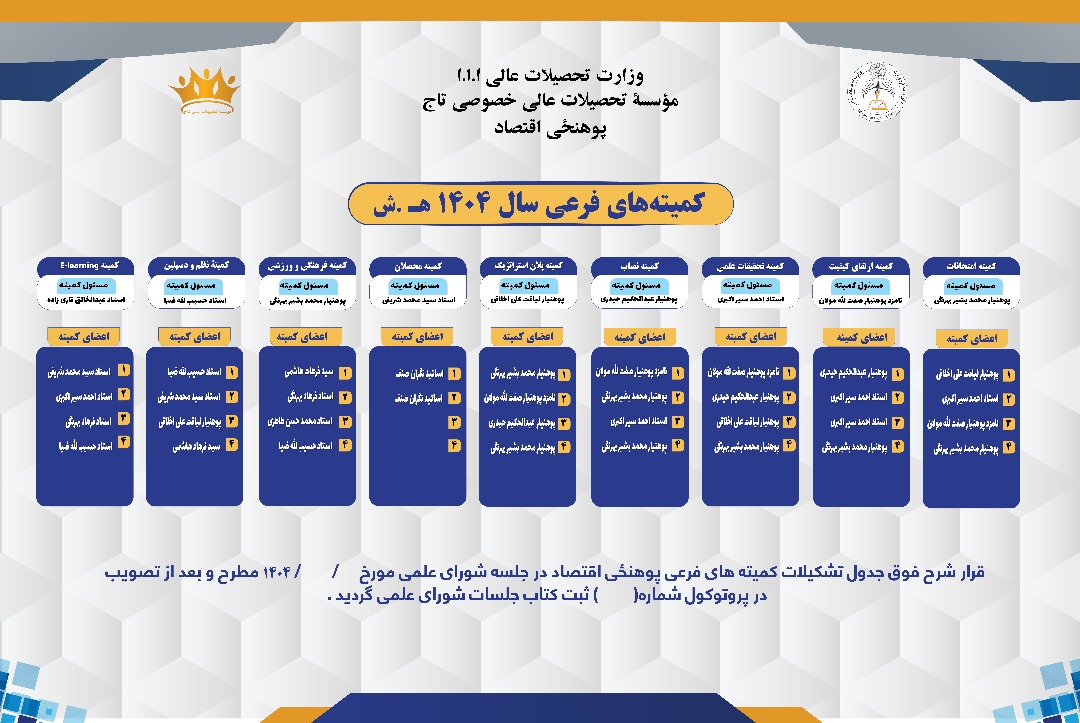
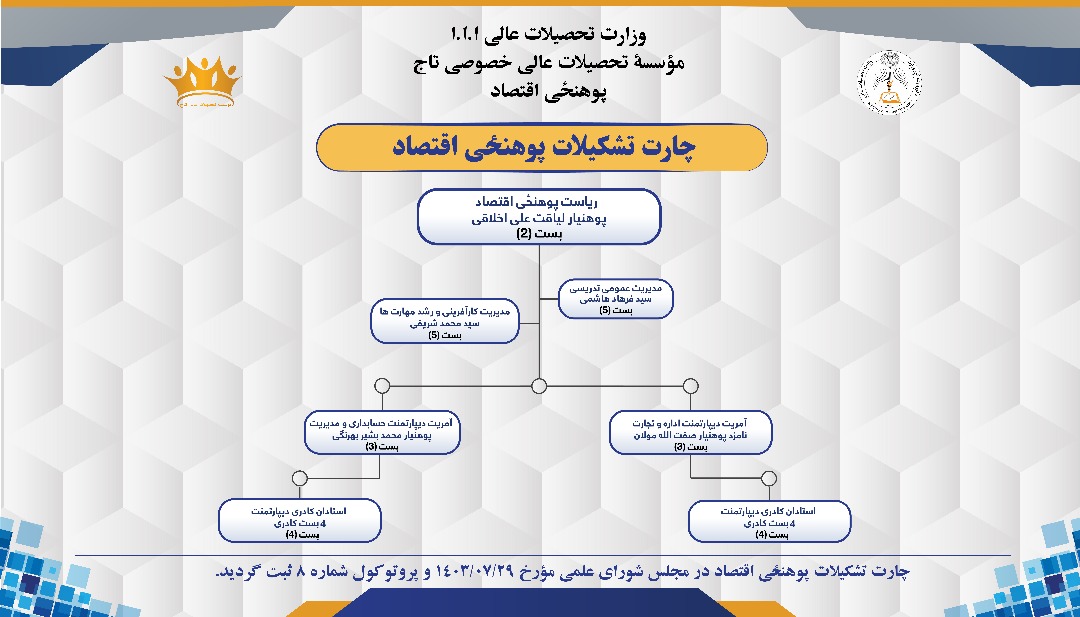
Organisation chart of the faculty
Registration for the new academic year
With a 20% discount in the Faculties of Economics and of Law and Political Science.