


Faculty of Medicine
From teaching to practice, and from diagnosis to treatment
Brief introduction to the Faculty of Medicine
Dated: 19 May 2010
Introduction to the faculty
The Faculty of Curative Medicine was established in 2010 as a faculty within Taj Private University. According to the curriculum, study in the Faculty of Curative Medicine takes seven years — six years of theory and one year of internship — after which a student graduates successfully at MD level. About 757 students from different provinces of Afghanistan are engaged in academic and professional studies in this faculty, taught by 10 permanent and 29 contract lecturers in clinical, para-clinical and basic-science subjects. Since its founding the faculty has had 12 graduating classes, giving society about 1,250 young doctors at bachelor’s (MD) level.
Lecturer profilesVision and mission
Faculty of Medicine
Vision
The Faculty of Curative Medicine intends, within the next five years, to become a leading and prominent faculty in the northern zone of the country.
Faculty of Medicine
Mission
With a specialist staff equipped with technology, the Faculty of Curative Medicine regards raising a creative young generation with clinical, research and teaching skills, and providing health services to meet the country’s social needs in the field of medicine, as its mission, and is committed to it.
Core values of the faculty
1: Respecting the admirable Islamic and Afghan values of society
2: Respecting and honouring academic freedoms
3: Observing the ethical values of medical practice in the medical community
4: Putting justice and equality into practice
5: Building a sound administration
6: Quality in teaching, research, technology and advisory services
7: Transparency in carrying out assigned work and making a culture of justice real in the medical community
8: Embedding a spirit of creativity and scientific innovation among Curative Medicine students
Department-related material
Introduction to the Curative Medicine department
The Curative Medicine department is a graduating department and a vital part of the Faculty of Medicine of Taj Private University. It carries out its work — organisation, leadership, planning, control, review, and drafting of procedures — in line with the laws and regulations of the Ministry of Higher Education, and reports to the faculty’s academic council and the academic deputy office.
Specifications of the Curative Medicine department
Academic programme: Curative Medicine
Academic programme in English: (Curative Medicine)
Faculty: Medicine
Level: Bachelor’s
Type of graduation certificate: MD
Years of study: seven years (6 years of theory, 1 year of internship)
Number of semesters: 12 semesters
Teaching weeks per semester: (16 teaching weeks)
Course system: credit system
Admission requirements: a twelfth-grade school graduation certificate, a passing mark in the Kankor exam, and meeting the conditions set out in the Ministry’s regulations
Curriculum of the Curative Medicine department
| First semester
Curative Medicine |
Second semester
Curative Medicine |
Third semester
Curative Medicine |
Fourth semester
Curative Medicine |
Fifth semester
Curative Medicine |
Sixth semester
Curative Medicine |
Seventh semester
Curative Medicine |
Eighth semester
Curative Medicine |
Ninth semester
Curative Medicine |
Tenth semester
Curative Medicine |
Eleventh semester
Curative Medicine |
Twelfth semester
Curative Medicine |
|---|---|---|---|---|---|---|---|---|---|---|---|
|
Physics |
Physics |
Anatomy |
Anatomy |
Anatomy |
Physiology (4) |
Pathology (3) |
Pathology (4) |
Infectious diseases (2) |
Anaesthesia (2) |
Internal medicine (2) |
Internal medicine (2) |
|
Chemistry (4) |
Chemistry (4) |
Histology (4) |
Histology (4) |
Physiology (4) |
Biochemistry (4) |
Pharmacology (3) |
Pharmacology (4) |
Tuberculosis (2) |
Urology (2) |
Surgery (4) |
Paediatric surgery (2) |
|
Biology (4) |
Biology (4) |
Embryology (2) |
Physiology (4) |
Biochemistry (4) |
Microbiology (4) |
Parasitology (2) |
Internal medicine (4) |
Pharmacology (2) |
Internal medicine (4) |
Paediatrics (3) |
Paediatrics (4) |
|
English (4) |
Genetics (2) |
Biophysics (2) |
Medical ethics (1) |
Microbiology (4) |
Pathology (5) |
Internal medicine (4) |
Fundamentals of surgery (4) |
Internal medicine (4) |
Surgery (4) |
Gynaecology (2) |
Gynaecology (2) |
|
First aid (2) |
English (2) |
English (3) |
English (3) |
Islamic culture (1) |
Islamic culture (1) |
General surgery (4) |
Public health (2) |
Surgery (4) |
Radiology (2) |
Traumatology and orthopaedics (2) |
Orthopaedics (2) |
|
Islamic culture (1) |
Islamic culture (1) |
Islamic culture (1) |
Islamic culture (1) |
Public health (2) |
Islamic culture (1) |
Radiology (2) |
Obstetrics (2) |
Ear, nose and throat (3) |
Ophthalmology (3) |
||
|
Computer (1) |
Islamic culture (1) |
Research methods (2) |
Obstetrics (2) |
Dermatology (3) |
Neurology (2) |
Psychiatry (2) |
|||||
|
Public health (2) |
Public health (2) |
Neurosurgery (2) |
Forensic medicine (2) |
||||||||
|
Public health (1) |
Behavioural sciences (1) |
||||||||||
|
Public health (1) |
|||||||||||
| Total credits (19) | Total credits (18) | Total credits (17) | Total credits (18) | Total credits (18) | Total credits (18) | Total credits (19) | Total credits (21) | Total credits (20) | Total credits (21) | Total credits (21) | Total credits (21) |
Strategic plan of the Faculty of Medicine 2025–2029
This is the first-quarter report of the approved implementation plan for 2025; the report is as follows.
Download the report Download the strategic planAcademic staff of the faculty
| Name | Job title | Level of education | Field of study |
| Dr. Mohammad Javid “Ebrahimi” (permanent) | Dean of the faculty, academic staff | Specialist | Orthopaedics |
| Dr. Mohammad Asef Maroof “Nabizada” (permanent) | Deputy dean of the faculty, academic staff | Master’s | Specialist in general internal medicine |
| Dr. Noor Mohammad “Matin” (permanent) | Head of the Curative Medicine department, academic staff | MD | Physiology |
| Dr. Mirwaisuddin “Ansari” (permanent) | Academic staff | Specialist | Paediatrics |
| Dr. Ahmad Munir “Yazdanparast” (permanent) | Academic staff | MD | Microbiology |
| Dr. Ghulam Haidar “Moshtari” (permanent) | Academic staff | Master’s | Histology |
| Dr. Gulbuddin “Ilyar” (permanent) | Academic staff | Bachelor’s | Pharmacy |
| Dr. Naqibullah “Faryad Afghan” (permanent) | Academic staff | Master’s | Biochemistry |
| Dr. Noor Ahmad “Sarmad” (permanent) | Academic staff | MD | Pathology |
| Dr. Mansour “Rahimi” (permanent) | Head of the health clinic, academic staff | MD | Anatomy |
| Mohammad Sabur “Saber” (permanent) | Teaching manager | Bachelor’s | Economics |
| Zaki “Nayebi” (permanent) | Laboratory technician | Bachelor’s | Laboratory |
| Mohammad Kazem “Noori” (permanent) | Executive manager | Bachelor’s | Economics |
| Dr. Zabihullah “Rahimi” (permanent) | Nurse | MD | Curative Medicine |
Experience the best with us
The Faculty of Curative Medicine strives to create the ground for research-based teaching, to train professional and committed staff, and to work to provide useful services to society.
Five-year plan
Drafting and approving a strategic plan for every five years in line with planning standards and the faculty’s needs
Research articles
Writing and printing research articles by the faculty’s academic staff in reputable national and international, domestic and foreign journals
Student programmes
Holding practical and applied programmes outside the curriculum and running quality-improvement workshops for students
Short-term goals of the faculty
- Creating the ground for standard teaching for applicants to Curative Medicine
- Obtaining the second-stage accreditation certificate from the Ministry of Higher Education
- Completing the staff (permanent lecturers) with MD specialists, master’s and PhD holders
- Holding conferences at national level
- Developing e-learning
- Creating a preparation course for the specialisation exam and the Exit exam for graduates of this faculty
Strategic goals of the faculty
- Raising quality and obtaining academic accreditation
- Developing research and scientific publications
- Improving twinning arrangements and scientific agreements
- Building capacity and completing the permanent academic staff
- Developing e-learning
- Developing the curriculum
- Creating new academic programmes
- Creating programmes to strengthen students
- Developing infrastructure
- Developing administration and organisation
- Improving good governance
- Increasing fair access to higher education
- Expanding medical technology capacity
- Carrying out students’ practical programmes
- Helping to monitor the implementation of procedures and regulations concerning students
- Strengthening and developing the professional ethics of students
Achievements
- Thirteen successful graduating classes from the Curative Medicine department
- More than 80 percent of this faculty’s graduates absorbed into government and private offices and organisations
- Recruited permanent academic staff at doctoral and master’s level, experienced and successful in teaching, in line with the Ministry of Higher Education’s appointment regulation, with the academic rank of assistant professor and assistant-professor candidate
- Some graduates of this faculty recruited as lecturers and academic staff members at the country’s state and private universities
- Concluded and implemented scientific cooperation agreements with the faculties of law and political science of state and private universities and with other state and private scientific institutions
- Seven textbook titles written and printed by academic staff of this faculty
- Research articles by the faculty’s academic staff written and printed in reputable domestic and foreign scientific journals
- Applied a standard, up-to-date curriculum in line with the Ministry of Higher Education’s cluster
- Successfully completed the periodic review of the two departments, Law, and Political Science and International Relations
- Drafted and approved a strategic plan for every five years in line with planning standards and the faculty’s needs
- Twenty percent of this faculty’s graduates joined and succeeded in higher master’s and doctoral studies at home and abroad
- More than 15 moot courts on criminal, legal, family and commercial subjects held by this faculty’s law students
- Eight crime-scene exercises held for the practical work of this faculty’s law students by state officials, the criminal technique unit and the legal clinic
- Successfully held more than 20 simulations of world political bodies, such as the United Nations, the Security Council, the Islamic Conference, diplomatic etiquette and presentation of credentials, for students of political science and international relations
- Holding various discussions, seminars and scientific conferences in every semester by lecturers and students on different legal and political subjects
Committees of the Faculty of Medicine
| Committee | Chair and secretary | Chart and regulation |
|
Quality Enhancement Committee |
Dr. Professor Naqibullah Faryad Afghan |
Download the organisation chart and regulation |
|
E-learning Committee |
Dr. Ahmad Munir Yazdanparast |
Download the organisation chart and regulation |
|
Examinations Committee |
Dr. Ghulam Haidar Moshtari |
Download the organisation chart and regulation |
|
Student Committee |
Dr. Noor Ahmad Sarmad |
Download the organisation chart and regulation |
|
Committee for drafting the strategic plan and monitoring its implementation |
Dr. Mohammad Asef Maroof |
Download the organisation chart and regulation |
|
Scientific Research Committee |
Dr. Mirwaisuddin Ansari |
Download the organisation chart and regulation |
|
Cultural and Sports Committee |
Dr. Gulbuddin Ilyar |
Download the organisation chart and regulation |
|
Curriculum Committee |
Dr. Mansour Rahimi |
Download the organisation chart and regulation |
|
Order and Discipline Committee |
Dr. Mansour Rahimi |
Download the organisation chart and regulation |
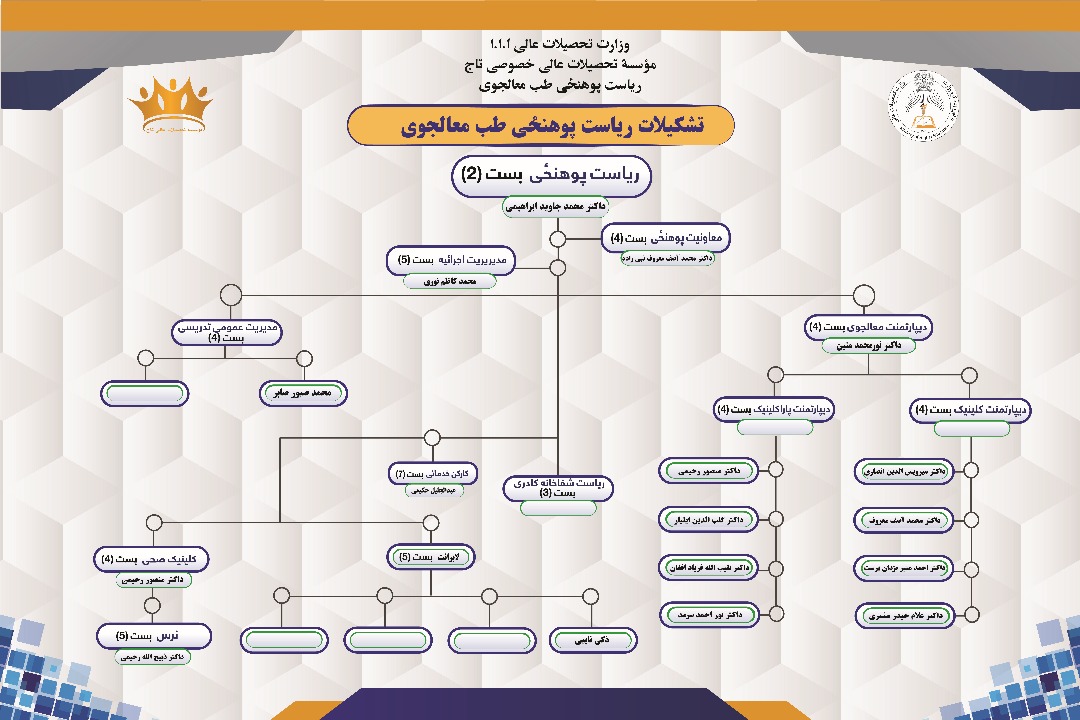
Organisation chart of the faculty
Registration for the new academic year
With a 20% discount in the Faculties of Economics and of Law and Political Science.